
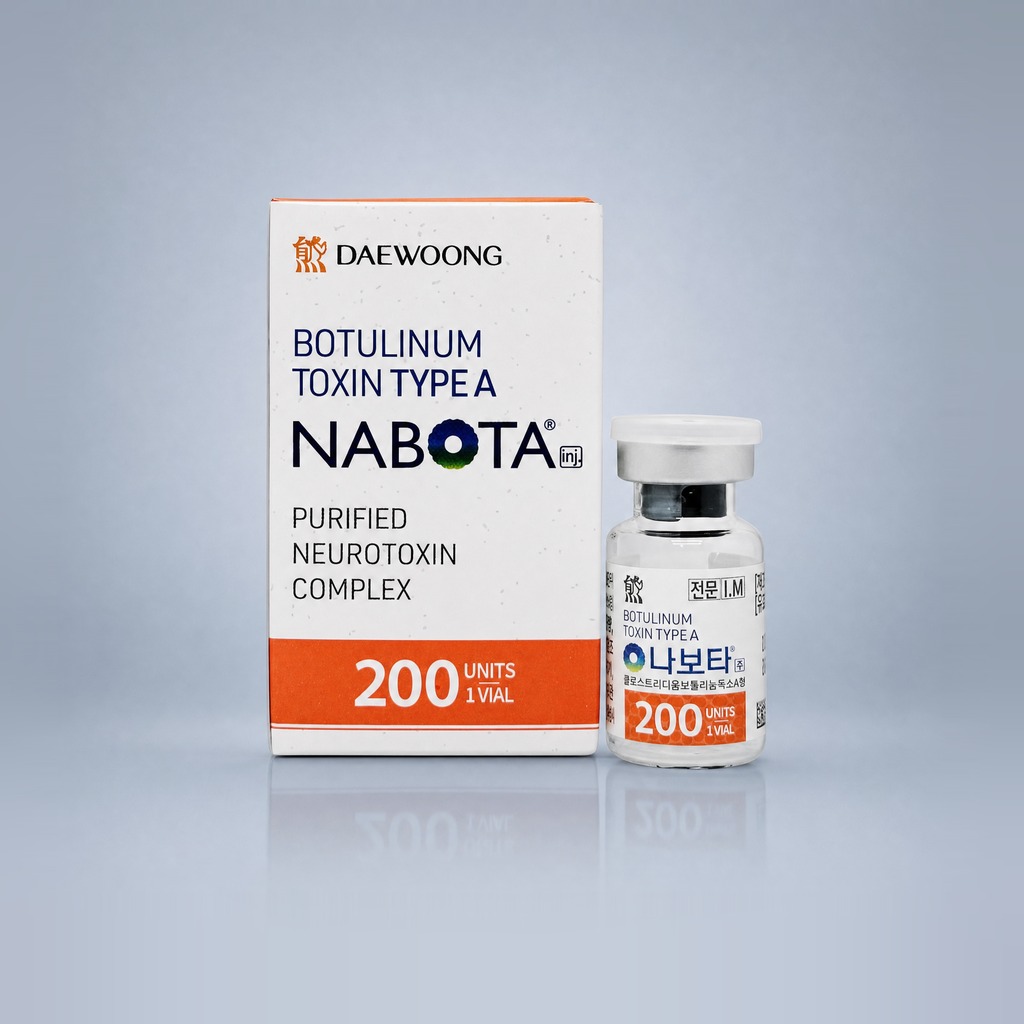
Nabota is Daewoong’s botulinum toxin type A, marketed in the US as the FDA-approved Jeuveau. It is a vacuum-dried complex-type (~900 kDa) preparation with human serum albumin and sodium chloride, supplied as a 200 U vial and reconstituted with preservative-free saline before injection. The Korean Nabota vial is registered with Korea’s MFDS and is not itself the FDA-listed product; Jeuveau is. Potency units are product-specific. Professional use only.
What is Nabota?
Nabota is Daewoong’s botulinum toxin type A, sold in the US as the FDA-approved Jeuveau. Like the original branded toxin, it is vacuum-dried rather than freeze-dried, a complex-type (~900 kDa) preparation with human serum albumin and sodium chloride and no preservative, here in a 200 U vial. It is reconstituted with preservative-free saline before injection. Potency units are specific to this product and are not interchangeable with other botulinum toxin products.
How does Nabota compare with other Korean toxins?
Nabota is vacuum-dried, which sets it apart from freeze-dried Korean toxins such as Botulax. Its maker holds a US FDA approval (Jeuveau), though the Korean Nabota vial itself is not the FDA-listed product. It is a complex-type toxin, unlike Coretox (free of complexing proteins).
| Nabota | Daewoong · vacuum-dried · 100/200 U |
|---|---|
| Botulax | Hugel · freeze-dried · 100/200/300 U |
| Coretox | Medytox · free of complexing proteins · 100 U |
What do clinics use Nabota for?
Clinics select Nabota for facial expression-line work and other aesthetic indications decided by the treating professional. Dosing and technique are product-specific and follow the manufacturer’s labelling; units are not interchangeable with other toxins.
Commonly selected for
- Clinics preferring a vacuum-dried toxin
- Practices standardised on Daewoong units
- 200 U vial caseloads
- Aesthetic expression-line protocols
How is Nabota supplied?
One 200 U vacuum-dried single-use vial with no preservative. Supplied vacuum-dried; reconstitute with preservative-free 0.9% sodium chloride before use. Reconstitute immediately before use and follow the manufacturer’s handling instructions.
Reviewed against publicly available manufacturer information. Indications, dosing and technique are product-specific per the manufacturer’s labeling and are decided by the treating clinician.
Specifications
| Brand | Nabota (Daewoong) |
|---|---|
| Manufacturer | Daewoong Pharmaceutical Co., Ltd. (South Korea) |
| Origin | South Korea |
| Active | Botulinum toxin type A (200 U) |
| Composition | Clostridium botulinum type A toxin, complex type (~900 kDa); with human serum albumin and sodium chloride; contains complexing proteins; no preservative |
| Units | 200 U |
| Format | 200 U vacuum-dried single-use vial |
| Areas | Facial expression lines (aesthetic use) |
| Delivery | Reconstitute with preservative-free 0.9% saline; inject intramuscularly per the practitioner’s protocol |
| Regulatory | Registered with Korea’s MFDS. Its maker, Daewoong, also produces Jeuveau (prabotulinumtoxinA-xvfs), which is approved by the U.S. FDA; the Korean Nabota presentation itself is not FDA-approved. |
| Administration | Injectable — by a qualified medical professional only |
| Storage & handling | Store refrigerated (2–8 °C) per the manufacturer’s instructions. |
Frequently asked questions
Is Nabota the same as Jeuveau?
Nabota is Daewoong’s Korean product; the same toxin is approved by the U.S. FDA under the name Jeuveau. The Korean Nabota vial itself is registered with Korea’s MFDS and is not the FDA-listed pack.
Is Nabota freeze-dried?
No. Nabota is vacuum-dried, like the original branded toxin, and is reconstituted with preservative-free saline before use.
Does it contain complexing proteins?
Yes. It is a complex-type (~900 kDa) toxin with human serum albumin and sodium chloride, and no preservative.
How is it supplied?
As one 200 U vacuum-dried single-use vial, reconstituted with preservative-free 0.9% saline before use.
Are its units interchangeable with other toxins?
No. Potency units are specific to this product and are not converted 1:1 to other botulinum toxin products.