
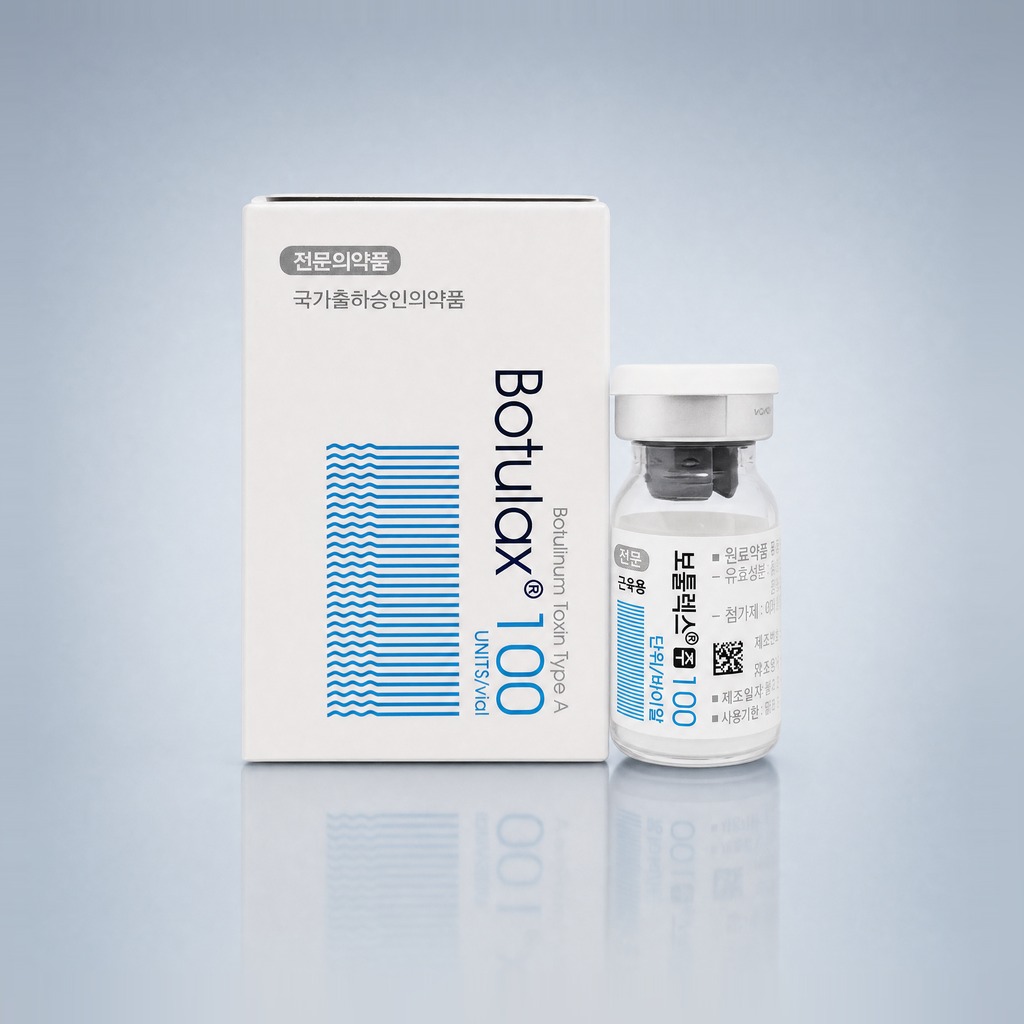
Botulax is Hugel’s botulinum toxin type A: a complex-type (~900 kDa) freeze-dried preparation with human serum albumin and sodium chloride, supplied as a 100 U single-use vial and reconstituted with preservative-free saline before intramuscular injection. It is registered with Korea’s MFDS; Hugel’s FDA-approved toxin is a separate product, LETYBO, and this Korean Botulax vial is not itself FDA-approved. Potency units are product-specific. Professional use only.
What is Botulax?
Botulax is Hugel’s botulinum toxin type A, one of Korea’s most widely exported aesthetic toxins. It is a complex-type (~900 kDa) freeze-dried preparation stabilised with human serum albumin and sodium chloride, supplied here as a 100 U single-use vial. It is reconstituted with preservative-free saline before injection. Potency units are specific to this product and are not interchangeable with other botulinum toxin products.
How does Botulax compare with other Korean toxins?
Botulax is a complex-type toxin (it retains the accessory complexing proteins), which distinguishes it from Coretox, positioned as free of complexing proteins, and from the ready-to-use liquid Innotox. It sits alongside Nabota among the major Korean units.
| Botulax | Hugel · complex-type · freeze-dried · 100/200/300 U |
|---|---|
| Nabota | Daewoong · vacuum-dried · 100/200 U |
| Coretox | Medytox · free of complexing proteins · 100 U |
| Innotox | Medytox · ready-to-use liquid · 50/100 U |
What do clinics use Botulax for?
Clinics select Botulax for facial expression-line work and other aesthetic indications decided by the treating professional. Dosing, dilution and injection points are product-specific and follow the practitioner’s protocol and the manufacturer’s labelling; potency units are not interchangeable with other toxins.
Commonly selected for
- Clinics wanting an established, high-volume Korean toxin
- Practices standardised on Hugel units
- 100 U vial format for their caseload
- Aesthetic expression-line protocols
How is Botulax supplied?
One 100 U single-use vial. Supplied as a lyophilised (freeze-dried) preparation; reconstitute with preservative-free 0.9% sodium chloride before use. Reconstitute immediately before use and follow the manufacturer’s handling instructions.
Reviewed against publicly available manufacturer information. Indications, dosing and technique are product-specific per the manufacturer’s labeling and are decided by the treating clinician.
Specifications
| Brand | Botulax (Hugel) |
|---|---|
| Manufacturer | Hugel Inc. (South Korea) |
| Origin | South Korea |
| Active | Botulinum toxin type A (100 U) |
| Composition | Clostridium botulinum type A toxin, complex type (~900 kDa); with human serum albumin and sodium chloride; contains complexing proteins |
| Units | 100 U |
| Format | 100 U single-use vial |
| Areas | Facial expression lines (aesthetic use) |
| Delivery | Reconstitute with preservative-free 0.9% saline; inject intramuscularly per the practitioner’s protocol |
| Regulatory | Registered with Korea’s MFDS. Its maker, Hugel, also produces LETYBO (letibotulinumtoxinA), which is approved by the U.S. FDA; the Korean Botulax presentation itself is not FDA-approved. |
| Administration | Injectable — by a qualified medical professional only |
| Storage & handling | Store refrigerated (2–8 °C) per the manufacturer’s instructions. |
Frequently asked questions
What is Botulax?
A botulinum toxin type A made by Hugel in South Korea, supplied as a freeze-dried 100 U vial reconstituted with saline before injection.
Is Botulax FDA-approved?
No. The Korean Botulax product is registered with Korea’s MFDS. Hugel separately makes LETYBO (letibotulinumtoxinA), which is approved by the U.S. FDA, but that is a different product.
Does it contain complexing proteins?
Yes. Botulax is a complex-type toxin (~900 kDa) and contains the accessory complexing proteins, along with human serum albumin and sodium chloride.
Can Botulax units be converted 1:1 to other toxins?
No. Potency units are specific to this product and are not interchangeable with other botulinum toxin products; dosing follows the manufacturer’s labelling.
How is it supplied and stored?
As one 100 U single-use vial, reconstituted with preservative-free saline before use, and stored and handled per the manufacturer’s instructions.